The Three Numbers Every Owner Should Know by Heart
The Three Numbers Every Owner Should Know by Heart
You know your truck. You know what pressure your pump runs, what mix strips a driveway without burning the concrete, how long a two-story vinyl job takes.
Then somebody sends you a P&L and you go blank.
Forty lines. Words you didn't pick. A number at the bottom that never feels like what's in the bank. So you close it and go back to running the machine.
Here's what nobody told you. You don't have to understand accounting. Ever.
You have to know three numbers by heart. Like your phone number.
Break-even. Cost per hour. Net margin.
Three. Not thirty. And each one falls out of one month of your own books in about a minute.
The month we're working from
One truck. You and a helper. August in Louisiana, the phone won't stop, you're running six days some weeks.
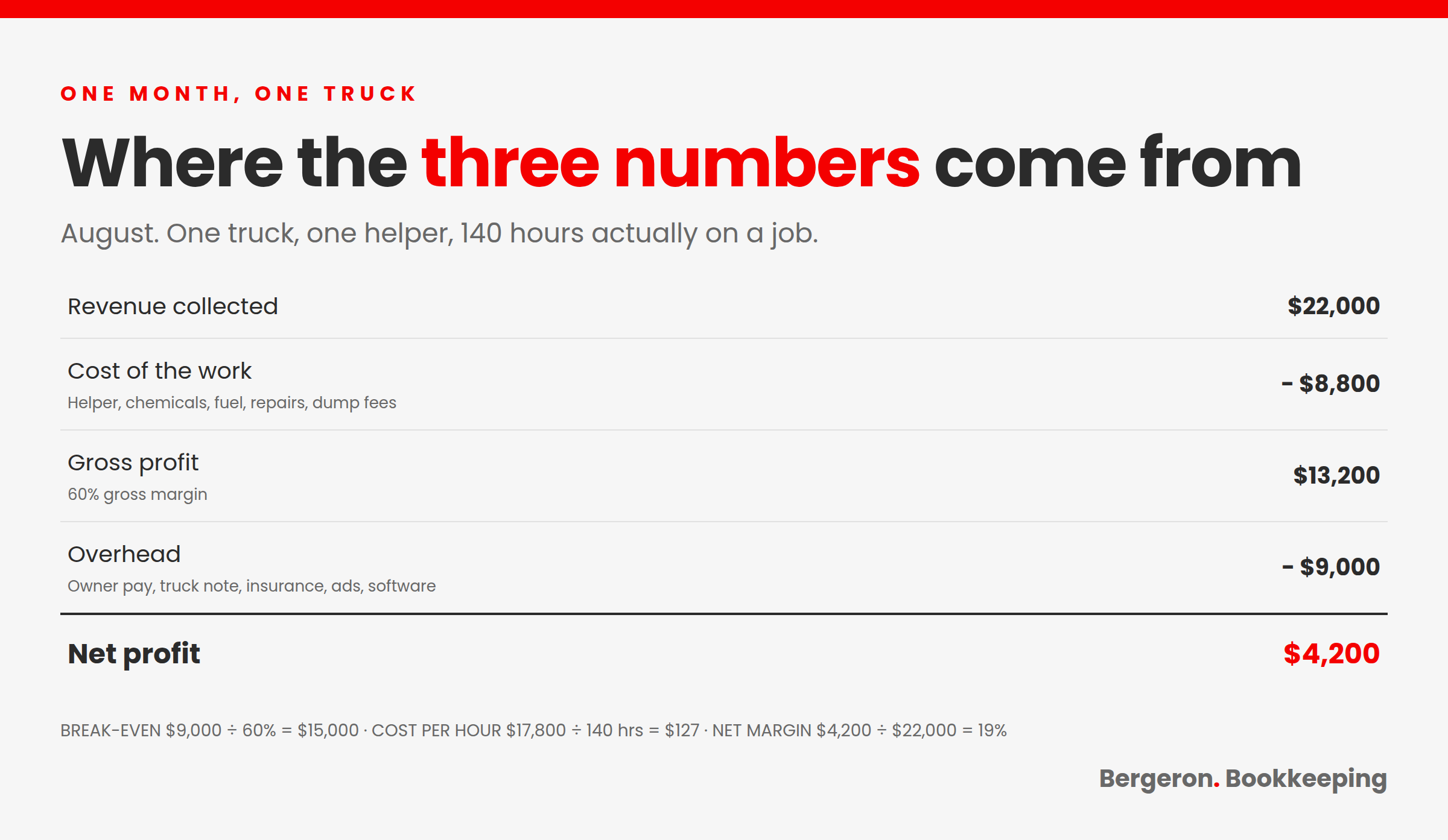
You collected $22,000.
Cost of doing the work — helper's pay with taxes and comp on it, chemicals, fuel, repairs, dump fees — came to $8,800. That leaves $13,200. Sixty cents of every dollar. That 60% is your gross margin.
Then the bills that hit whether the truck rolls or not. Your pay, the truck note, the trailer, insurance, ads, phone, software, storage. $9,000.
You kept $4,200.
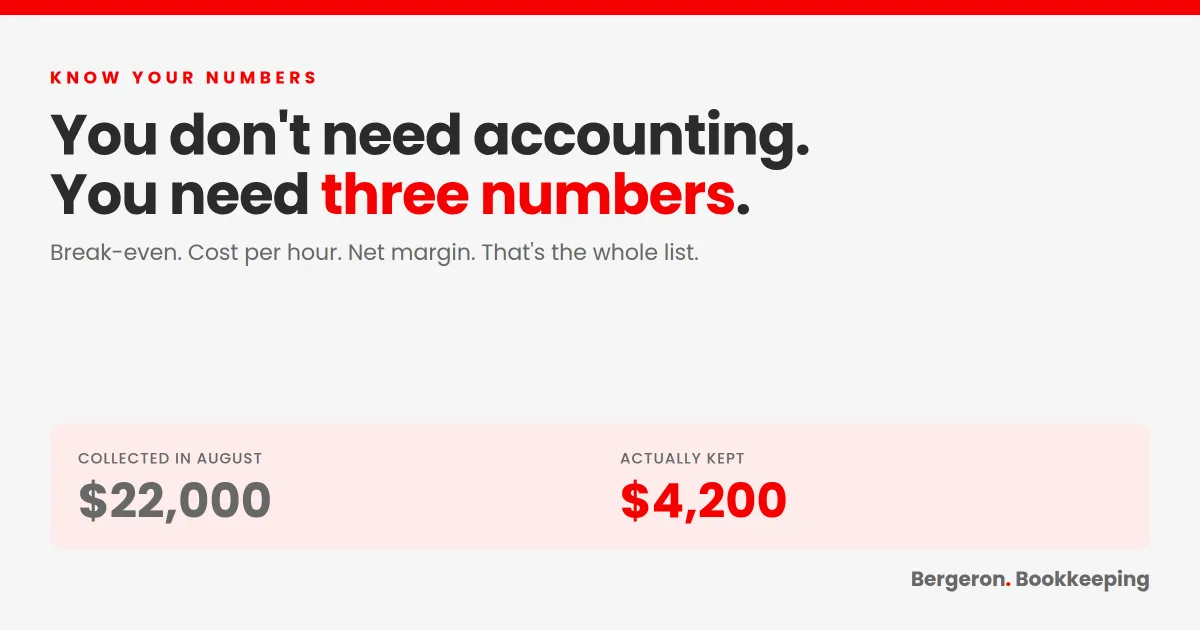
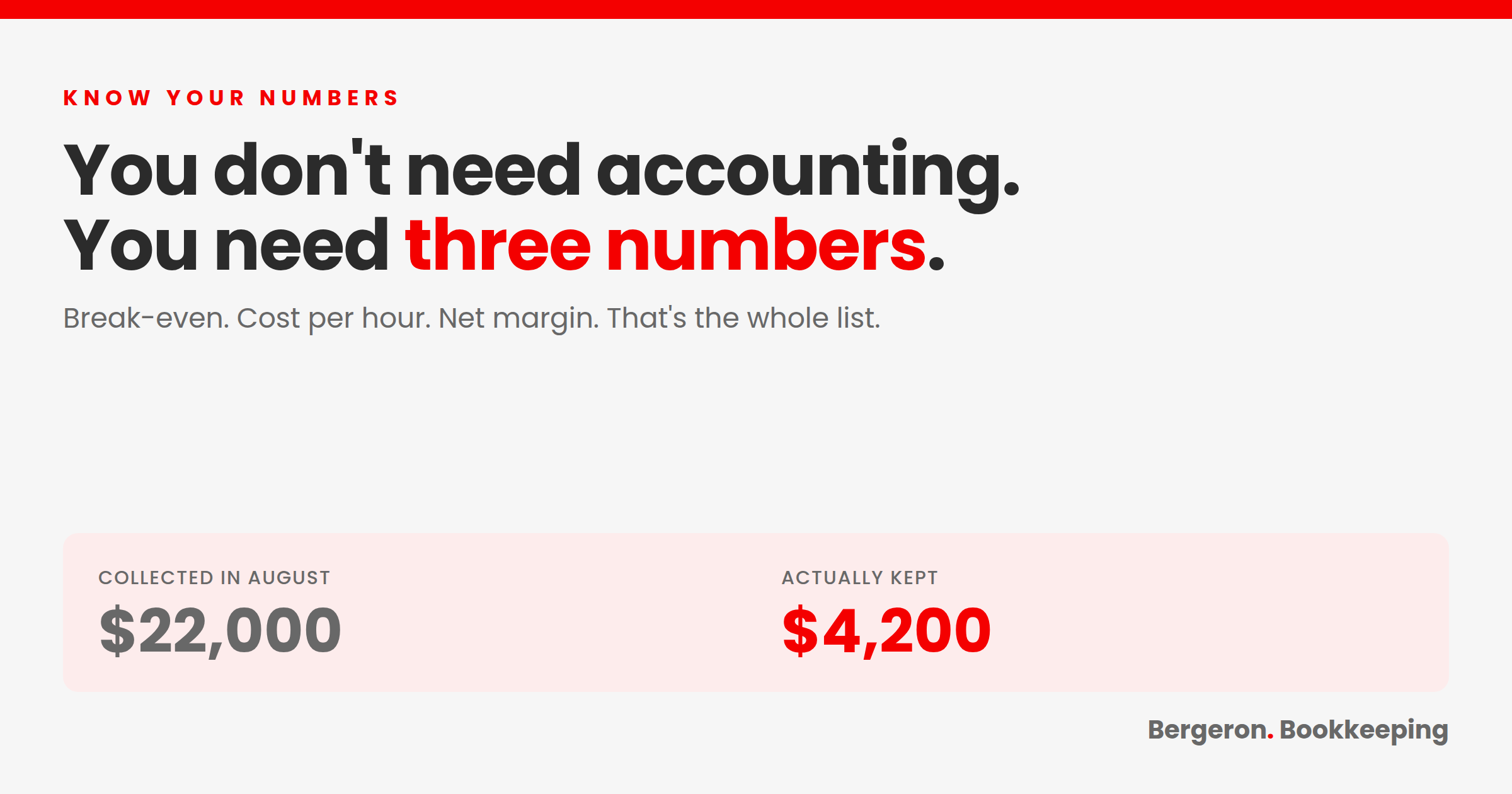
Twenty-two grand collected, forty-two hundred kept. Now watch the three numbers fall out of that.
Number 1 — Break-even. What you must collect before you make a dollar.
What it is: the point where you stop losing and start making. Not a goal. A line.
How to find it in under a minute: monthly overhead divided by your gross margin.
$9,000 ÷ 0.60 = $15,000.
That's the whole calculation. Fifteen thousand has to come through the door every month before one dollar of it is yours.
What to do with it: paint it on the inside of your truck door. Sunday night, look at what you collected. Over $15,000 you made money. Under it you paid for the privilege of working.
The bad version: you do $9,000 in January and call it a slow month.
It isn't. $9,000 at a 60% margin is $5,400 of gross profit against $9,000 of overhead.
You didn't have a slow January. You had a $3,600 hole, and every dollar of it came out of the summer money you were counting on.
Same January, two different reactions, and the only difference is whether you knew the number.
Number 2 — Cost per hour. The floor under every quote.
What it is: what one hour of your operation costs, all in. The guy, the gas, the chemical, the truck note, the insurance, your pay — spread across the hours you actually work.
How to find it: add up every dollar you spent for the month. Cost of the work plus overhead. $8,800 + $9,000 = $17,800. Then divide by the hours you were really on a job.
Twenty days on the truck at seven real hours a day is 140. Not the hours you were on the clock — the hours the wand was moving. We covered drive time and dead hours Wednesday.
$17,800 ÷ 140 = $127 an hour.
Now set it next to what you bring in. $22,000 ÷ 140 is $157 an hour. You collect $157, you burn $127. That $30 an hour is your entire business.
What to do with it: never quote under $127 an hour again. Not for a friend, not to stay busy, not because the week looks light.
The bad version: a restaurant calls. Dumpster pad and the drive-thru lane, $300. You and your guy are there three hours.
$300 for three hours is $100 an hour. Your floor is $127. Those three hours cost you $381.
That job pulled $81 out of your pocket, and you sweated through an August afternoon to do it.
At your real margin it prices at $470. Not because you got greedy. Because $470 is what it costs to do that work and still be in business in March.
Number 3 — Net margin. The scoreboard.
What it is: the share of every dollar that's actually yours once everything's paid.
How to find it: net profit divided by revenue. $4,200 ÷ $22,000 = 19%.
Nineteen cents of every dollar stayed. Eighty-one went straight back out the door.
What to do with it: judge work by the percentage, not the size of the check. When something bigger shows up, run it against 19% before you say yes.
The bad version: somebody hands you a $30,000 month.
Best month you've ever had, on paper. But it's slow-pay commercial, the crew's stretched thin, you're renting a lift, and it lands at 8%. That's $2,400.
You did $8,000 more work and took home $1,800 less money. More miles on the truck, a worn-out helper, a smaller check.
You'd have grabbed it with both hands if the top line was the only number you watched.
Same month, same truck, two different owners
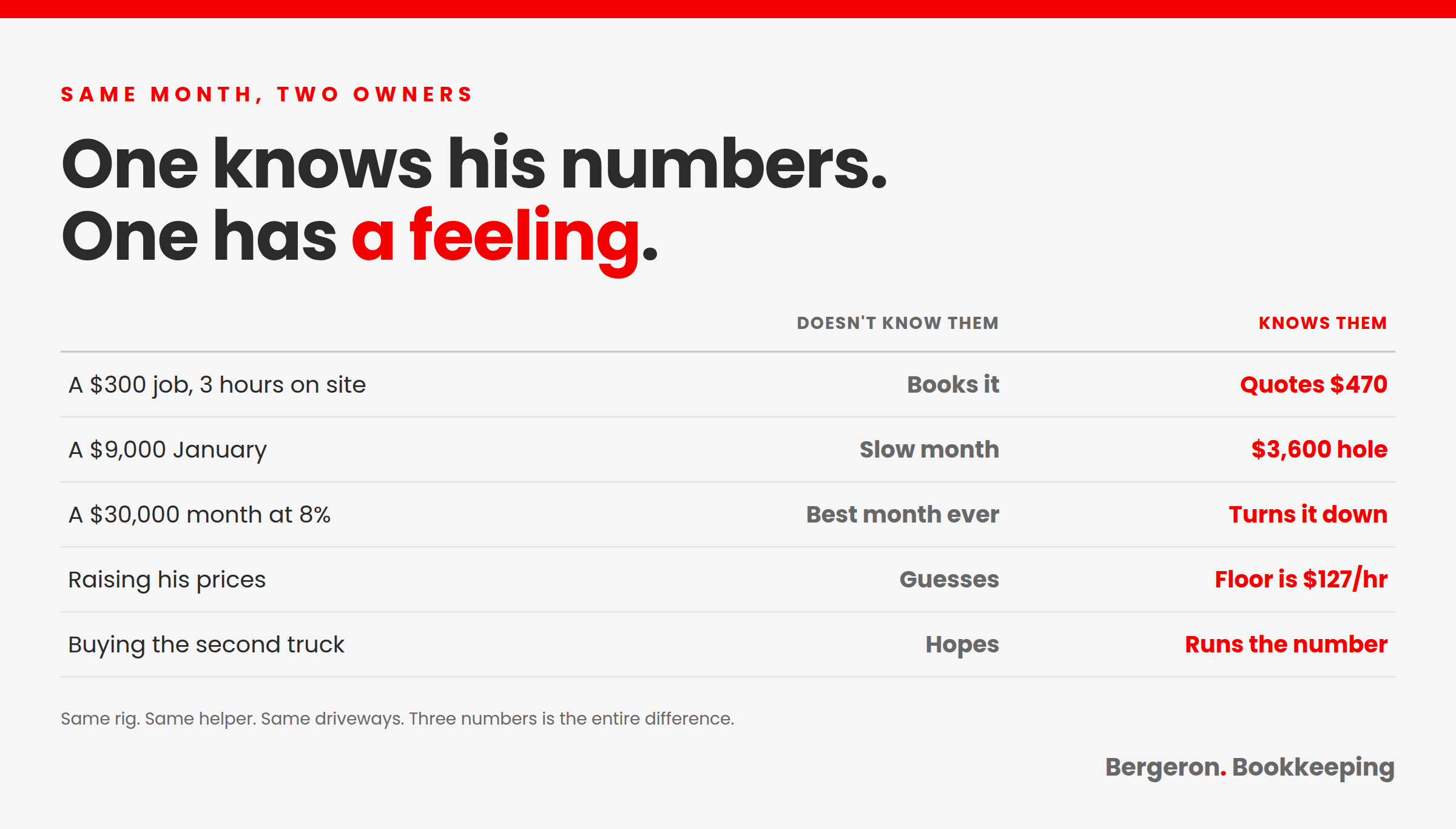
Nothing changed about the business. Same rig, same helper, same driveways. One guy has three numbers memorized, one guy has a feeling.
Of the 140 hours you worked in August, about 95 went to covering the business. Your $4,200 came out of the last 45. Two-thirds of the month for the truck, the last third for you.
That changes what comes out of your mouth when somebody asks you to squeeze in a cheap job Saturday.
Why nobody ever showed you this
Because there's no money in showing you.
Most accounting firms aren't in your corner, they're in your wallet. They file the return in April and bill you for the phone call when you ask what a line means. The confusion is the product — an owner who knows his own numbers doesn't need to call.
It took about a thousand words to hand you all three. There's no secret being protected here.
This is bigger than a spreadsheet. You've got a helper who's feeding somebody, and a family that plans around what you bring home. Know your break-even and you know in week one whether payroll is safe. Know your cost per hour and you stop taking work that quietly costs you money. Know your margin and you can look at that second truck and say yes or no like a man who ran the math.
That's not accounting. That's knowing where you stand, and it's the difference between running a business and being run by one.
The three numbers, one more time
Break-even — overhead ÷ gross margin. $9,000 ÷ 60% = $15,000. What you have to collect before a dollar is yours.
Cost per hour — every dollar you spent ÷ hours actually on a job. $17,800 ÷ 140 = $127. The floor under every quote.
Net margin — net profit ÷ revenue. $4,200 ÷ $22,000 = 19%. The scoreboard you judge work by.
Fifteen minutes with last month's P&L gets you all three. Then memorize them like your phone number, because that's about how often you'll need them.