Commercial vs. Residential: Which One Actually Pays
Commercial vs. Residential: Which One Actually Pays
Everybody in every group you're in says the same thing.
Get out of residential. Quit washing houses for six hundred bucks. Get commercial accounts, get contracts, get the big tickets, stop dealing with homeowners who want to argue about a rust spot on a fence post.
And you believe it. You've seen a guy post a $2,400 invoice for one night of work. You've done four houses in a day to make less than that.
So you start chasing commercial. You get one. Then another one.
And six months later, running the biggest book of work you've ever had, you can't cover payroll on a Thursday.
Here's the part that makes no sense until somebody shows you
The guys in the group aren't lying to you. Commercial really does pay better.
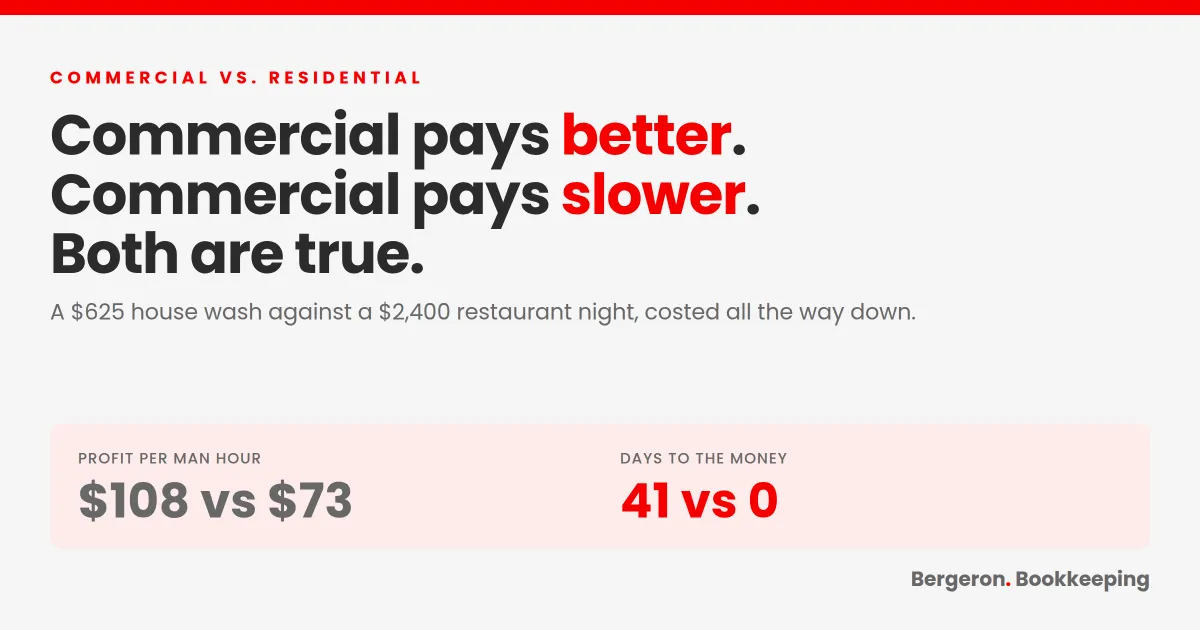
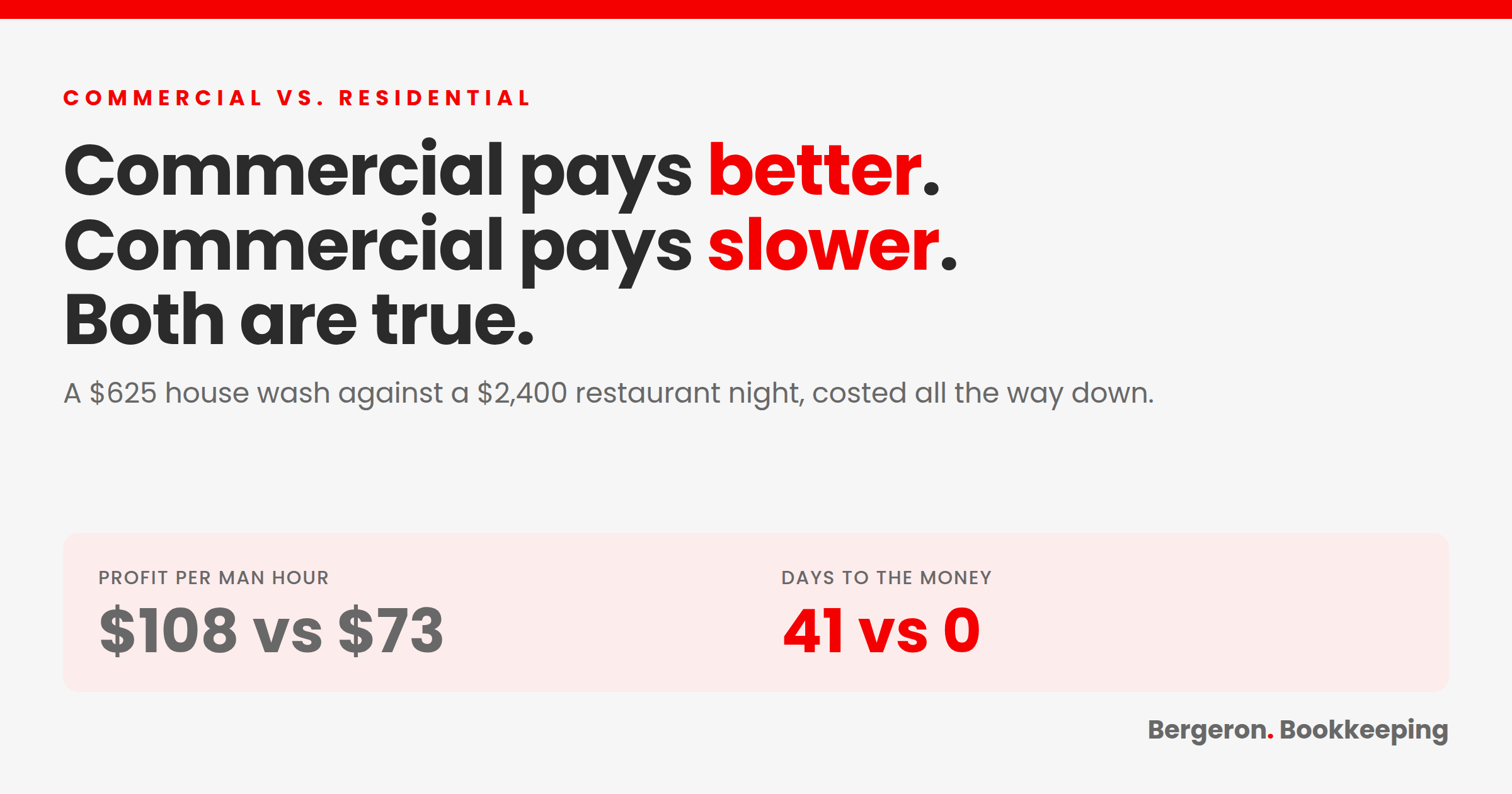
I ran both jobs all the way down. Commercial made $108 an hour on the man. Residential made $73.
Commercial won. It wasn't close.
And it's the thing that almost put that man under in October.
The house first
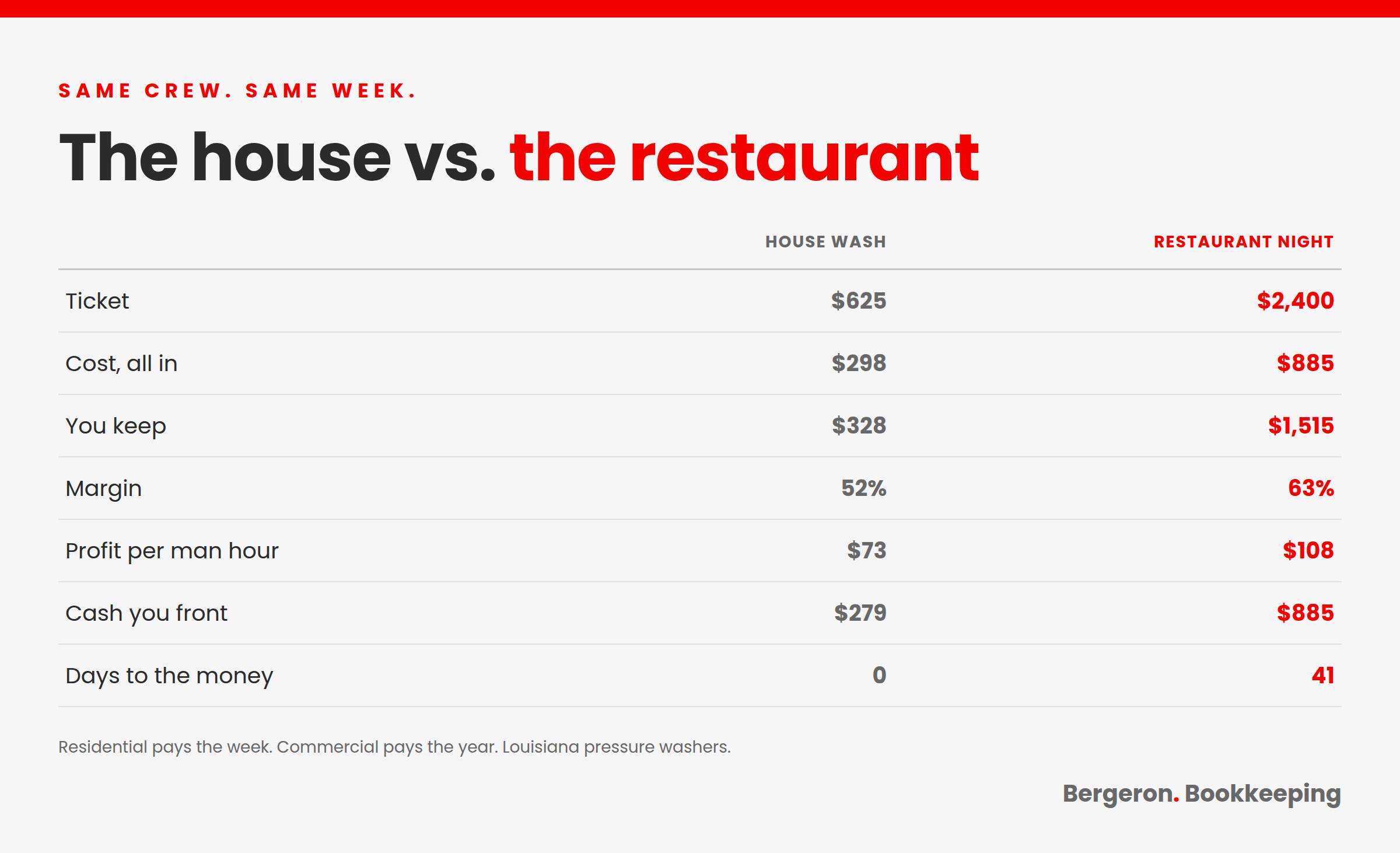
One story house wash and the driveway. $625. Card on file, you ran it in the driveway before you rolled up the hose. Four and a half hours on site, one guy.
Loaded labor, $42.55 an hour. That's your helper's $18 with his taxes and comp on top, then divided down by the fact only about 55% of the hours you pay for are hours you can bill. Four and a half hours, $191.
Chemical, $38. Five gallons of 12.5% at $4.60, some surfactant, degreaser for the driveway.
Machine hours, $32. Fuel, $18. Card fee, $19.
$298 out. $625 in. You kept $328 and you kept it that same afternoon.
Now the restaurant chain
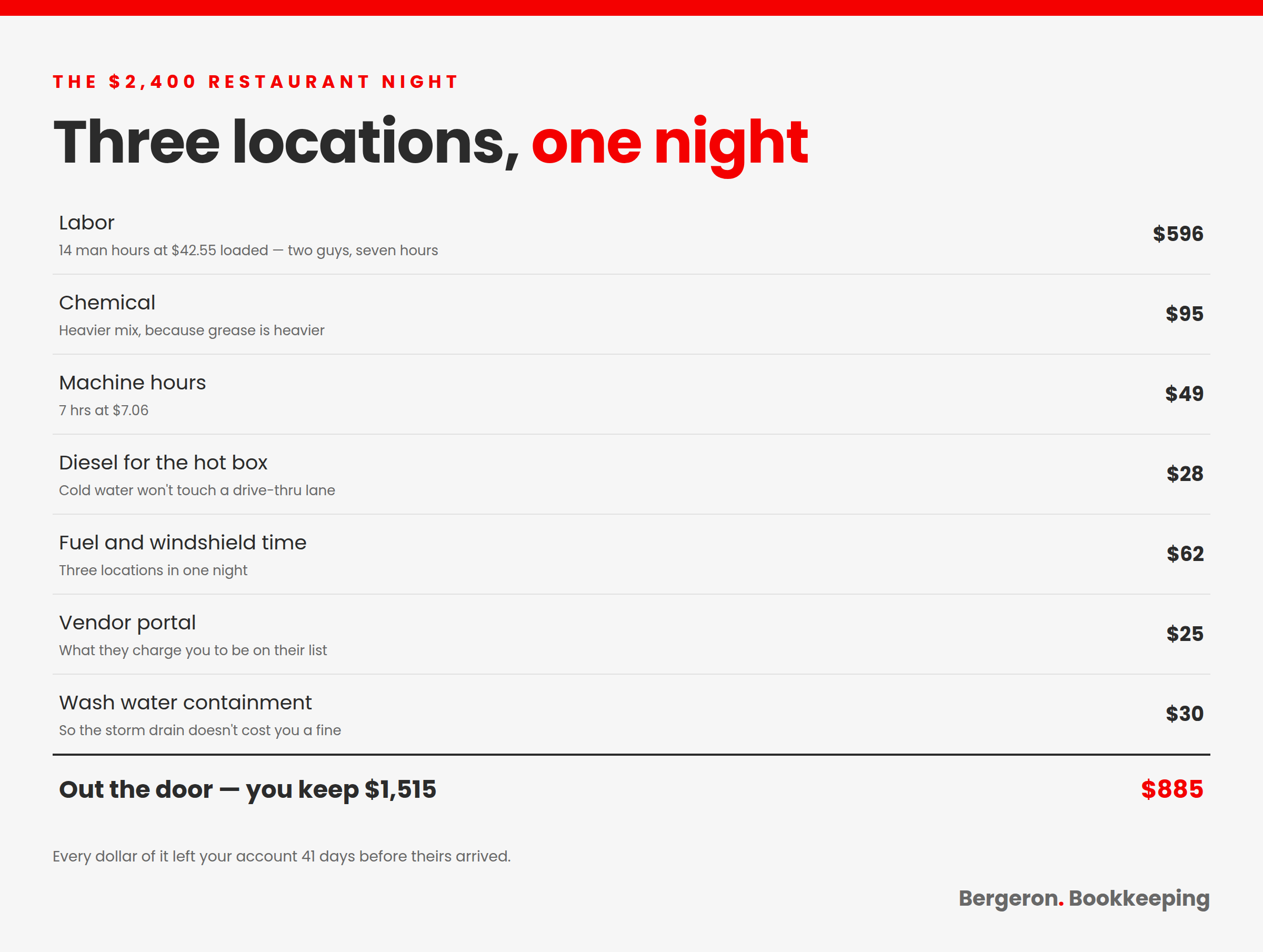
Three locations in one night. Concrete, dumpster pads, the drive-thru lane. $2,400, Net 30.
Two guys, seven hours on the clock. Fourteen man hours at $42.55, thats $596.
Chemical is heavier because grease is heavier, $95. Machine hours $49. Diesel for the hot box, $28, because cold water don't touch a drive-thru lane. Fuel and windshield time between three locations, $62.
Then the two nobody counts. The vendor portal they make you pay to be in, about $25 spread across the job. And containment for the wash water so you don't get a fine at the storm drain, $30.
$885 out. $2,400 in. You kept $1,515.
Lets be honest about the hourly
You'll see guys post that commercial is $216 an hour and residential is $73. Thats how it looks on the clock.
But that $216 is two men. The $73 is one. Compare it man for man and its $108 against $73.
Commercial still wins. $35 more an hour on every man you put out there. On a fifty hour week that's $1,750.
I'm not going to sell it harder than it is. It doesn't need it.
So take the commercial work. Now go look at a calendar.
The house paid you the same day. Day zero.
The restaurant paid you on day 41. You did the work in one night in August, you had the money in October.
You paid your two guys nine days after that night. You paid the chemical bill. You paid the hot box diesel and the fuel and the containment.
$885 of your money went out and stayed out for forty one days.
This is the whole thing. Commercial is more profitable per hour and slower per dollar. Both of those are true at the same time, and only one of them shows up on your P&L.
This is the false profit narrative
Your books say you had a great August. Best month ever. And they're right.
Your bank account says you're scraping. And its right too.
Thats the false profit narrative — the business looks profitable because the profit is real, but its sitting in somebody's accounts payable and your bills came due in the meantime. The more commercial you sell, the bigger the gap gets. You grow yourself broke.
Guys quit at exactly this spot. Not because the work was bad. Because they were profitable and out of cash on the same Thursday, and nobody ever told them those two things could happen together.
What it actually takes to run a commercial book
Run your business on 41 day money and you need money in the bank to cover the wait.
Say your costs run $12,000 a month. That's payroll, fuel, chemical, insurance, the truck note, the shop rent.
$12,000 a month is $400 a day. Forty one days of that is $16,400.
That's the price of admission. Not a bigger trailer. Not a hot box. $16,400 sitting in an account doing nothing but letting you wait on other people.
If you've got it, commercial is the best move you will ever make. If you don't have it, commercial will chew you up while your P&L tells you everything is great.
So the answer isn't one or the other
I know what your thinking. "So do I drop commercial or not."
Neither. You need both, on purpose, in a ratio.
Residential pays the week. Commercial pays the year.
Here's the rule. Keep enough same-day residential work on the schedule to cover payroll and your fixed costs every single week, on its own, without one commercial check. Everything you win on top of that in commercial is the money that actually builds something — the second rig, the slow season fund, your own paycheck getting bigger.
The house wash isn't beneath you. Its the thing that lets you say yes to the restaurant.
Both ways, side by side
What this is really about
Your guys don't care what your margin was. They care that Friday works, every Friday, whether or not a restaurant group's AP clerk went on vacation.
When you've got residential covering the week, you can bid commercial from a calm place. You can hold your price. You can walk away from a bad one. You never have to take a job you know is priced wrong just to make a check clear.
Thats what cash in the bank actually buys you. Not comfort. Backbone.
And the men riding in that truck with you are feeding their families on your ability to say no to a bad deal. Thats a lot of weight, and its a lot easier to carry with $16,400 behind you.
Your accountant will look at that August and tell you it was a great month and file it. He won't tell you that you're forty one days from being cash broke, because that's not on the form he fills out. They are not in your corner, they're in your wallet.
The short version
Commercial really does pay better — $108 a man hour against $73.
Commercial also pays slower — day 41 against day zero.
Profitable and out of cash happen on the same Thursday. Thats the false profit narrative.
Running 41 day money at $12,000 a month costs you $16,400 sitting in the bank.
Residential pays the week. Commercial pays the year. Keep enough of both.