The 5-Minute Profit & Loss Walkthrough for Outdoor Service Businesses
The 5-Minute Profit & Loss Walkthrough for Outdoor Service Businesses
Your bookkeeper sends the P&L. You open it on your phone in the truck.
There's a big number at the top that looks pretty good. Then about forty lines of stuff underneath it. Then a number at the bottom that never looks as good as the top one.
You close it. You'll look at it later. Later never comes.
Here's the thing nobody told you: you're not supposed to read all forty lines. You're supposed to read four numbers and two percentages, and it takes five minutes.
Let me show you.
First, what a P&L actually is
A P&L is not a report card. Nobody's grading you.
It's a map of where the money went. Money came in the top, ran down through everything you spent it on, and whatever made it to the bottom is yours.
That's it. Four stops on the way down:
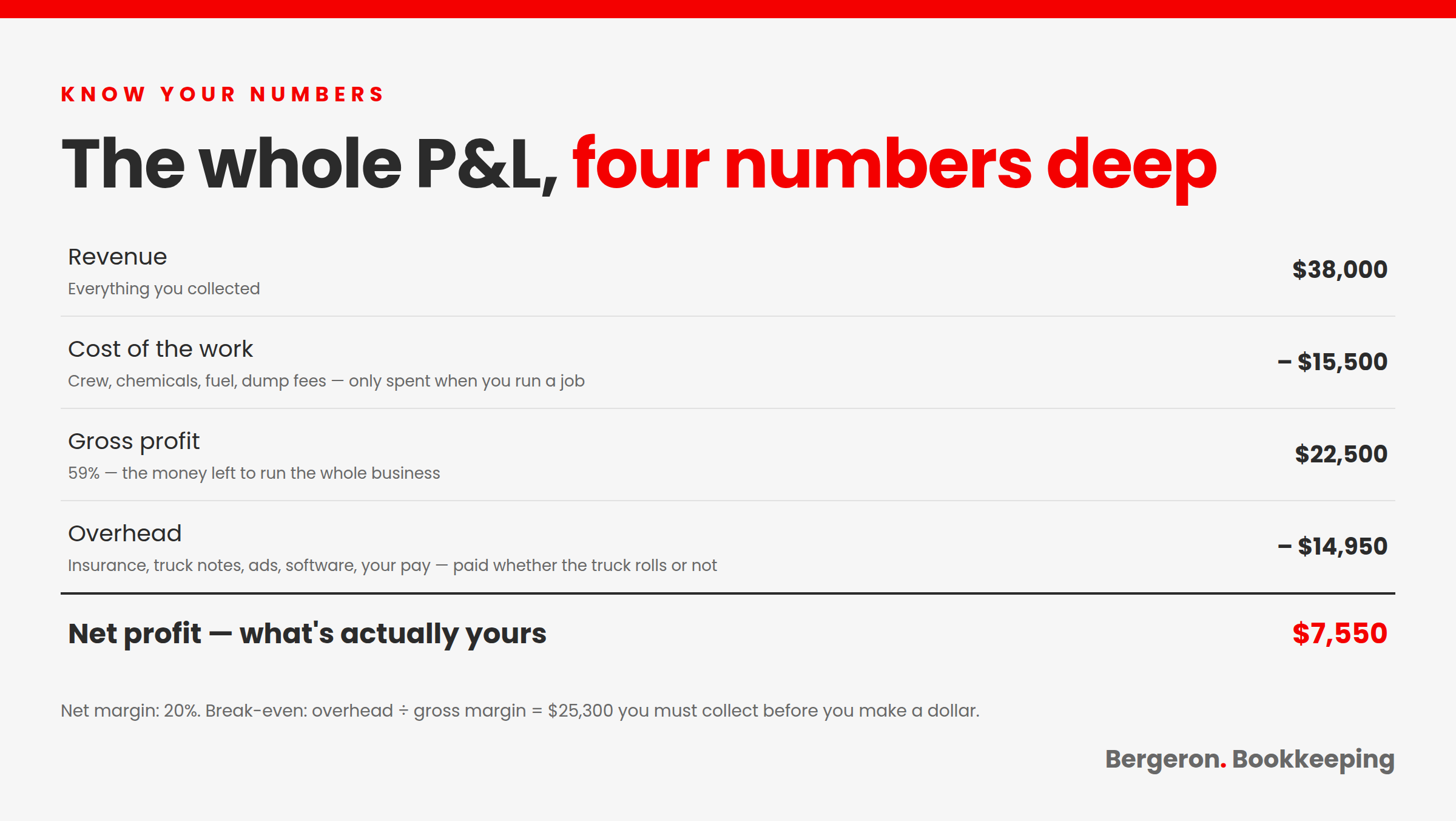
Revenue — everything you collected.
Cost of the work — what you spent to actually do the jobs. Crew, chemicals, fuel, dump fees. If you didn't run a job, you don't spend it.
Gross profit — what's left after doing the work. This is the money that has to run the whole business.
Overhead — what you pay whether the truck rolls or not. Insurance, truck notes, ads, software, your pay.
Net profit — what's actually yours.
Every line on that forty-line report belongs to one of those buckets. You don't need the lines. You need the buckets.
Minute 1: Top and bottom
Look at revenue. Look at net profit. Divide the bottom by the top.
$7,550 ÷ $38,000 = 20%.
That's your net margin, and it's the single number that tells you whether the month worked. Twenty cents of every dollar stayed. Eighty went back out.
Most outdoor service businesses run somewhere around 10–20% once the owner is paid properly. If you're under 10%, something's leaking. If you don't know your number at all, that's the leak.
Minute 2: Gross profit tells you if your pricing is right
This is the one people skip, and it's the most important.
Gross profit is revenue minus the cost of doing the work. In our month: $38,000 minus $15,500 is $22,500. As a percentage, that's 59%.
Here's what that number means in plain English. For every $100 job you run, $41 goes into actually running it and $59 is left over to pay for everything else.
If that percentage is falling, your pricing is the problem — not your spending. You can cut your phone bill all year and it won't touch this number.
Gross margin answers: am I charging enough? Net margin answers: am I keeping enough?
Two different questions. Two different fixes.
Minute 3: Overhead is your monthly nut
Overhead is everything you owe before a single truck leaves the shop. Truck notes, insurance, the ad spend, the software, your own paycheck. In our month that's $14,950.
Now do this: divide overhead by your gross margin.
$14,950 ÷ 0.59 = $25,300.
That's your break-even. You have to collect $25,300 in a month before you make one dollar. Below that you're paying for the privilege of working.
Write that number on the inside of your truck door. It's the most useful number in your business and almost nobody knows theirs.
Minute 4: Put last month next to this month
One month by itself tells you almost nothing. Two months next to each other tell you everything.
And here's the part that gets people — compare the percentages, not the dollars.
Look at what happened there.
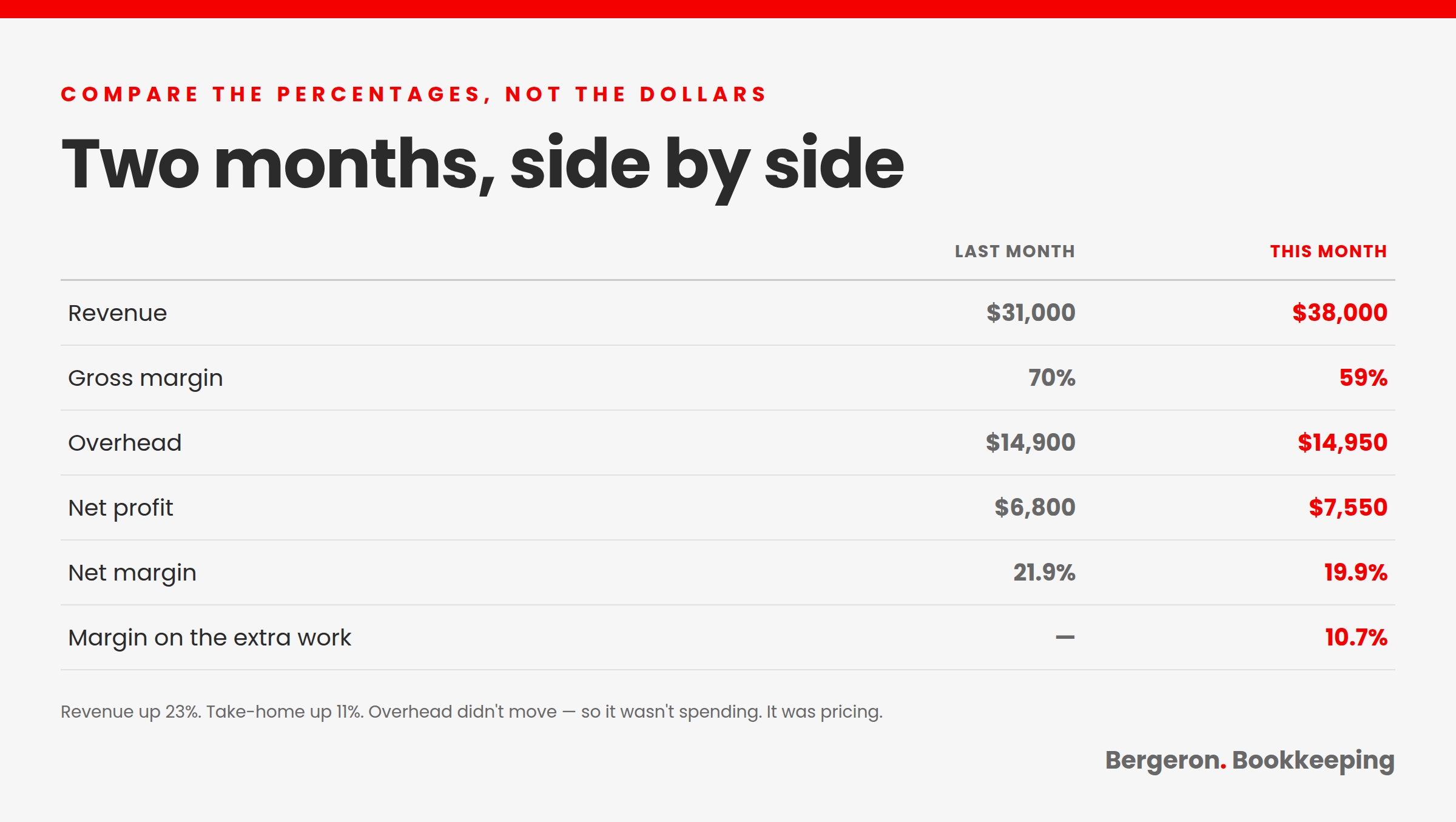
Revenue went from $31,000 to $38,000. That's $7,000 more, up 23%. Best month you've had all year. You felt it — the phone rang, the crew ran hard, the calendar was full.
Net profit went from $6,800 to $7,550.
You did $7,000 more work and kept $750 of it.
That extra work came in at about an 11% margin when your business runs at 20%. You worked a lot harder to earn about half as well.
If you only looked at the dollars, you'd have called that your best month and gone looking for more of exactly that work. The percentage is what told you the truth.
Minute 5: Pick one number. Just one.
Don't try to fix everything. Look at the two percentages and ask which one moved the wrong way.
Overhead barely moved — $14,900 to $14,950. So that's not it.
Gross margin fell from 70% to 59%. That's your answer. It's a pricing problem, not a spending problem. Something in that extra $7,000 was underpriced — a bid you sharpened your pencil on, a job that ran long, a customer you didn't want to lose.
The fix isn't cutting your ad budget. The fix is finding which jobs came in at 11% and not taking more of them.
One number. Next month you check whether it moved.
Why this keeps happening
Nobody sits down with you and explains this. Your CPA sends the return in April and moves on. Ask what a number means and you'll get a bill for the phone call.
That's backwards. You can't make a decision about a business you can't see.
Bergeron Bookkeeping keeps the books clean enough that this five-minute check actually works — the buckets sorted right, the numbers where you expect them, and a monthly walkthrough where we sit down and you ask whatever you want without watching a clock.
You're the one who has to decide whether to hire, whether to buy the trailer, whether to raise your prices. We just make sure you're deciding off real numbers instead of the feeling you get from the top line.
Quick recap
Don't read forty lines. Read four numbers.
Gross margin tells you if you're charging enough. Net margin tells you if you're keeping enough.
Overhead ÷ gross margin = your break-even. Know it by heart.
Always compare two months, and compare the percentages, not the dollars.
Pick one number to move. Check it next month.
Five minutes. Once a month. It's the cheapest thing you'll ever do for your business.