Downtime Is a Cost
Downtime Is a Cost
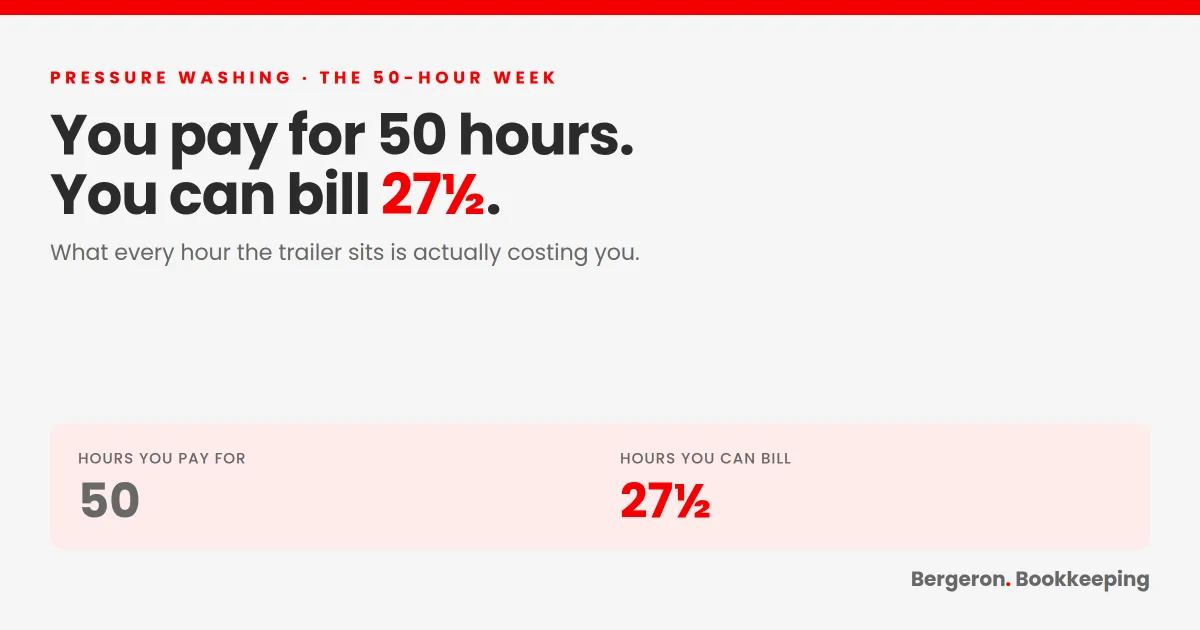
You worked fifty hours last week. You know you did. You left before six most mornings, you got home after dark, and you still finished Friday feeling behind.
So when you think about your pricing, fifty is the number sitting in your head. Fifty hours, times whatever you charge, that's the week.
Your customers didn't buy fifty hours.
They bought the hours where water was hitting concrete. The driving, the loading, the quote you ran across town to give, the afternoon a storm shut you down — you paid for every one of those yourself. Nobody reimbursed you.
Lets take a real week apart
One truck. One man on it at $18 an hour. Fifty hours on the clock Monday through Friday, and it was a good week — you stayed busy the whole time.
Here's where those fifty hours actually went.
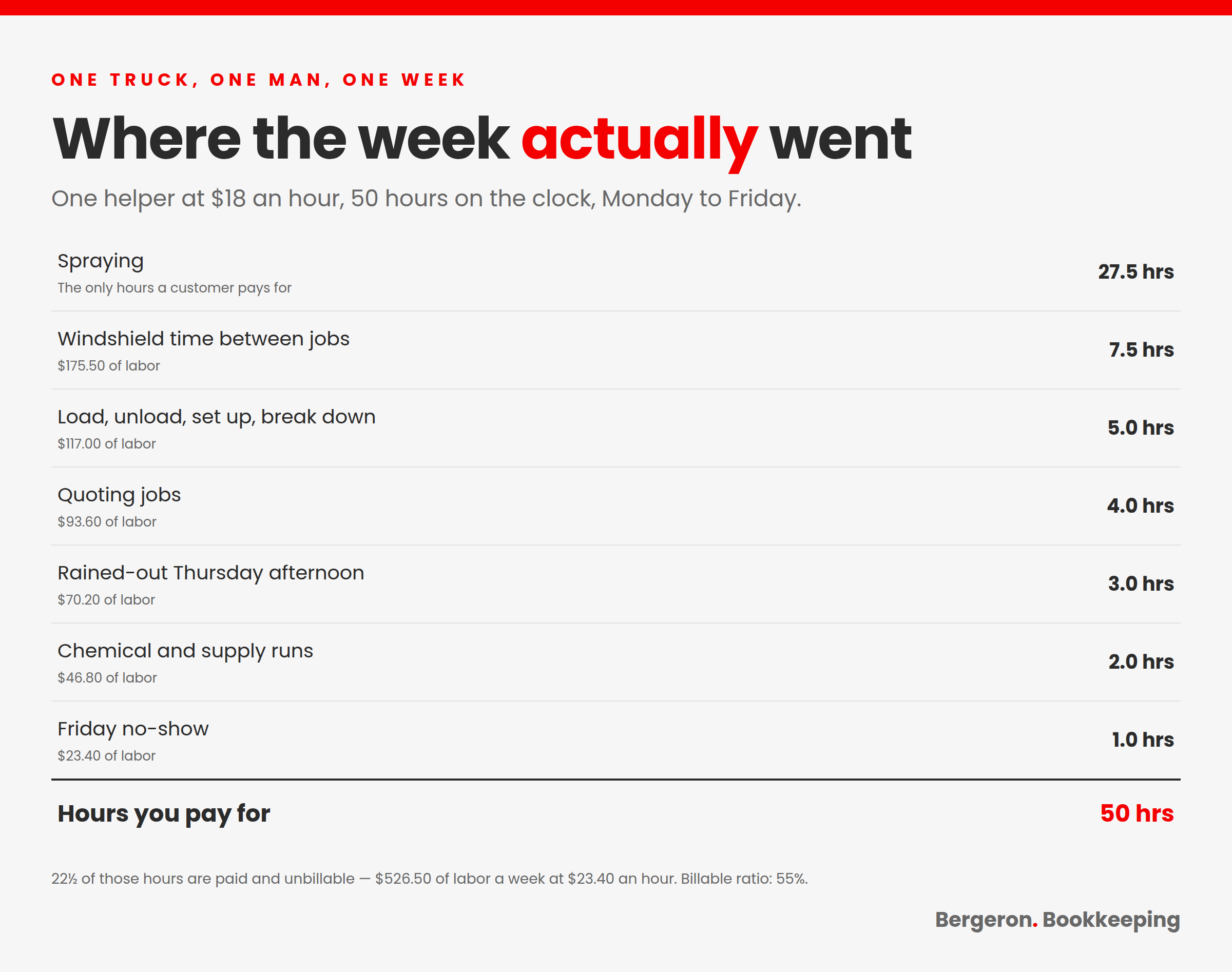
Twenty-seven and a half hours of spraying. Twenty-two and a half hours of everything else.
And none of that is wasted time. You can't wash a house you haven't driven to. You can't run the machine without loading it first. Quoting is how you get next week's work. That Thursday storm is Louisiana in August and it's going to happen again this week.
It's all necessary. It's just not billable.
Your billable ratio is 55%
That's the number to write down. Fifty-five percent.
Out of every hour you pay for, a little over half of it ends up on an invoice. The rest is paid time no customer is ever going to cover.
And that changes everything about what an hour costs you.
An $18 helper is not an $18 helper
You already knew he wasn't eighteen. Payroll taxes and workers comp push him to $23.40 an hour — we've run that math before.
So a three-hour house wash carries about seventy dollars of labor. Easy.
It carries a hundred and twenty-eight.
Here's why. You paid that man for all fifty hours. That's $1,170 for the week. But you've only got twenty-seven and a half hours to charge it against. Divide $1,170 by 27.5 and every billable hour is carrying $42.55 of labor, not $23.40.
Same guy. Same wage. Nineteen dollars an hour more than you thought, because the hours you can't bill still get paid for out of the hours you can.
That's the false profit narrative in its purest form. The week looks fine because you only counted the hours you sprayed.
Now put the machine on top
The rig runs you about $7.06 an hour — fuel, pump rebuilds, wear parts, and the money to replace it someday.
That one stays at $7.06, because the machine only burns while you're spraying anyway.
$42.55 of labor plus $7.06 of machine is $49.61. That's your floor per spraying hour. Not your price — your floor. Fuel in the truck, insurance, the truck note, your phone, and your own pay all come on top of that.
If you've been pricing off about thirty dollars an hour of cost and feeling good about forty-five, that right there is why the money never shows up.
One more thing, since we're being honest
I ran all of that at straight time.
Ten of those fifty hours are overtime. At time and a half, $18 becomes $27, and burdened that's $35.10 an hour for hours 41 through 50.
Now guess which hours those are. They're the back end of the week. The Friday no-show. The long drive home at six o'clock. You're paying premium money for the hours nobody is buying.
The real number is worse than the one I just showed you. I kept it conservative on purpose.
Both ways
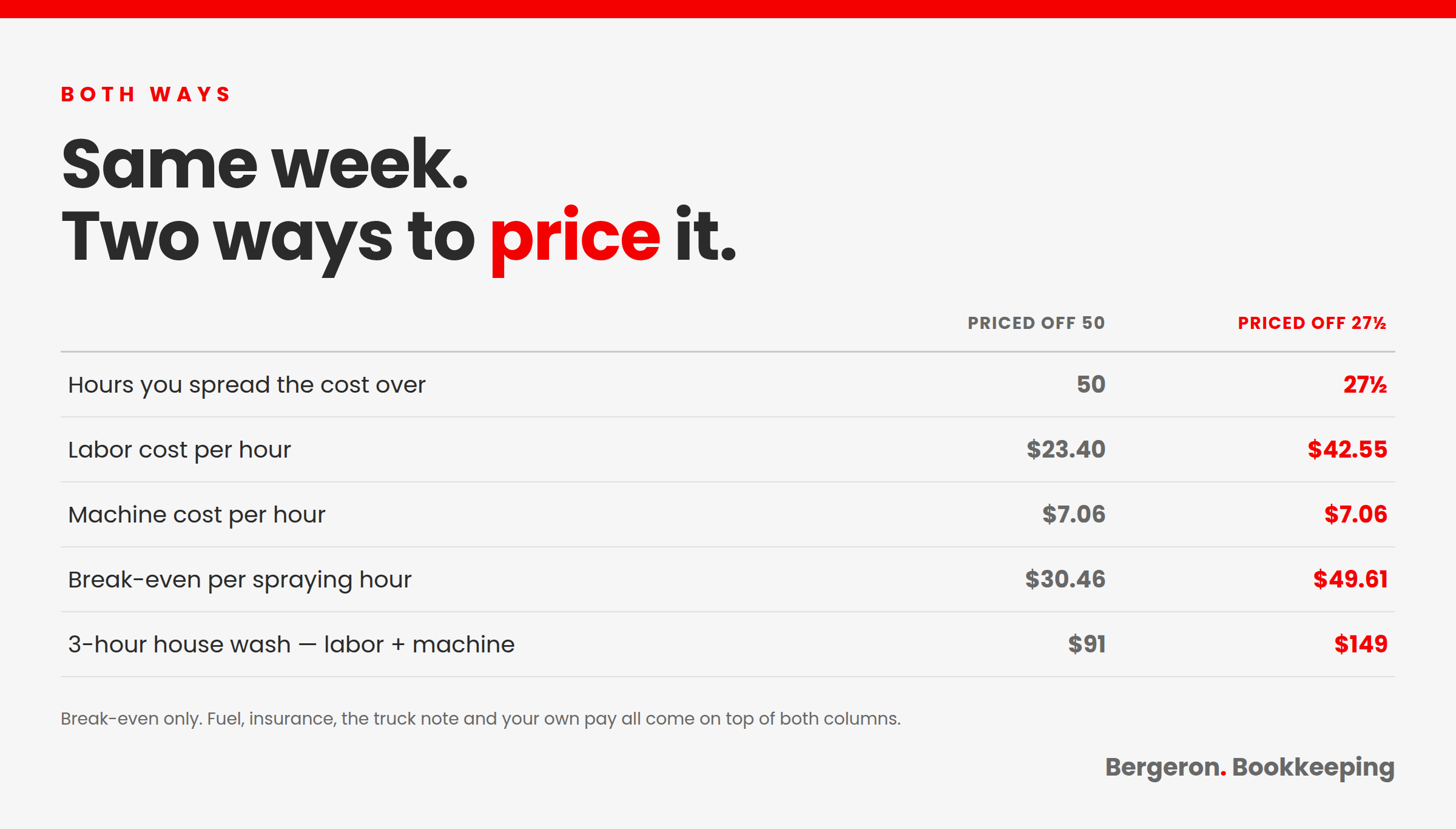
Same fifty hours. Same helper. Same rig. The only thing that changed is which number you divided your cost by.
Where the $526.50 went
Twenty-two and a half unbillable hours at $23.40 is $526.50 of labor every week that no invoice covers.
So bill your 27.5 hours at $75 and you brought in $2,062.50. In your head you paid $23.40 of labor and $7.06 of machine on each of those hours, so the week left you around $1,225.
The week left you $698.35.
The difference is $526.50 — the exact cost of the hours you paid for and couldn't sell. It didn't go anywhere strange. It went into windshield time, and rain, and a guy who wasn't home.
Your CPA is going to see $1,170 sitting in a bucket called "wages" and file it. Correct, and completely useless. He'll never tell you 45% of that payroll was time you couldn't sell, because he isn't looking and nobody pays him to look. Most accounting firms aren't in your corner, they're in your wallet.
What you do with this on Monday
Track your spraying hours for two weeks. Start time and stop time on the wand, in a notebook, that's the whole system. Now you've got your own billable ratio instead of mine.
Take your weekly labor and divide it by billable hours, not paid hours. That's your real labor rate.
Then price off that. Every job, every time.
The first part costs you nothing and you can start it tomorrow morning.
This is the number that decides things
You didn't get into this to run a truck. You got into it because you were good at the work and you wanted the money coming to you instead of somebody else.
Now there's a helper counting on Friday. There's a note on the truck. There's your family, and there's his.
When you price off fifty hours, every one of those people is getting paid out of a number that was wrong by almost half. It holds up fine while you're slammed. It stops holding up the first slow month — and October is closer than it feels right now.
That's the whole job of a real set of books, and it's what we do at Bergeron Bookkeeping: split your payroll into the hours you sold and the hours you ate, so your price stops being a guess.
You bet on yourself. Price like the whole week costs something, because it does.
Quick recap
You pay for 50 hours. You can bill about 27½. That's a 55% billable ratio.
Unbillable hours don't disappear. They get paid for out of the hours you can bill.
$23.40 of burdened labor becomes $42.55 per billable hour.
Add the rig at $7.06 and your floor is $49.61 per hour of spraying.
Write down start and stop times for two weeks and you'll have your own ratio instead of mine.