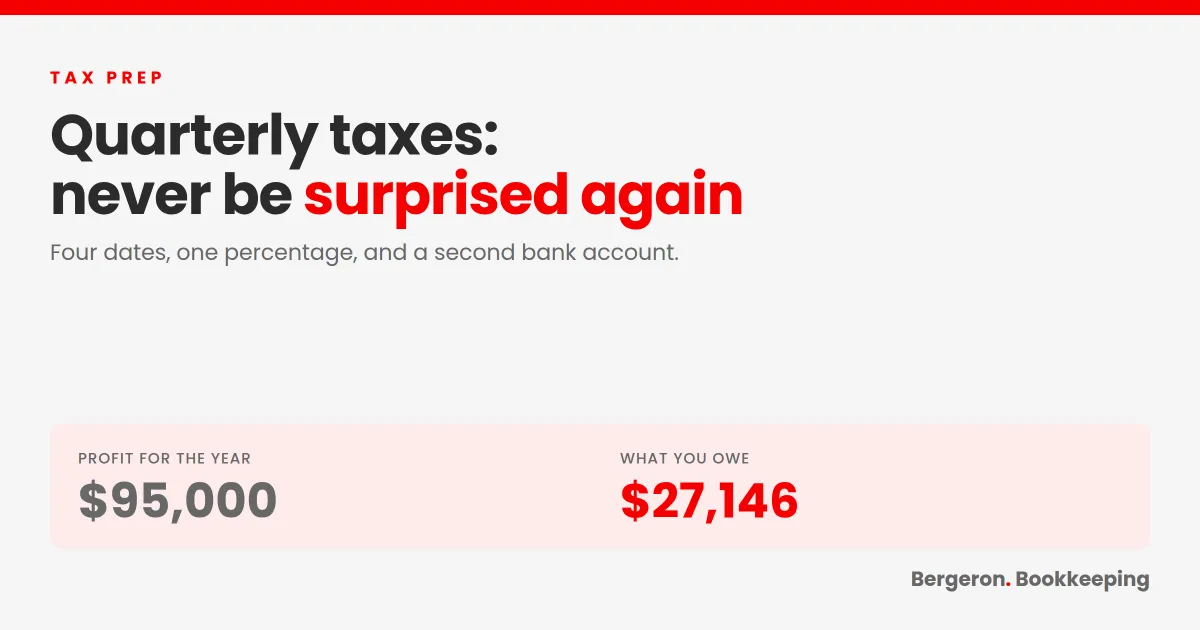
Quarterly Estimated Taxes: What to Pay, When, and How to Never Be Surprised
Quarterly Estimated Taxes: What to Pay, When, and How to Never Be Surprised
You had a good year. Trucks stayed busy, you added a guy, you finally took a real paycheck.
Then April came and your CPA said you owe $27,000.
You didn't spend it wrong. You spent it on the business, the way you always have — a machine, a trailer, payroll, the truck you needed. The money was real. It just already had somebody else's name on it and nobody told you.
Here's how that stops happening.
Why the bill exists at all
When you had a job, taxes came out of every check before you ever saw the money. You never had to think about it because somebody else was thinking about it for you.
When you work for yourself, nobody's doing that. The whole check hits your account and it feels like yours.
It isn't. About thirty cents of every profit dollar belongs to the IRS and the state, and they'd like it four times a year, not once.
That's all quarterly estimated taxes are. You doing what a payroll department used to do for you.
The number is 30% — and here's the proof
Everyone gives you a range. Ranges are useless when you're trying to decide what to move into savings on a Friday.
So here it is on a real number. Say your business cleared $95,000 in profit last year.
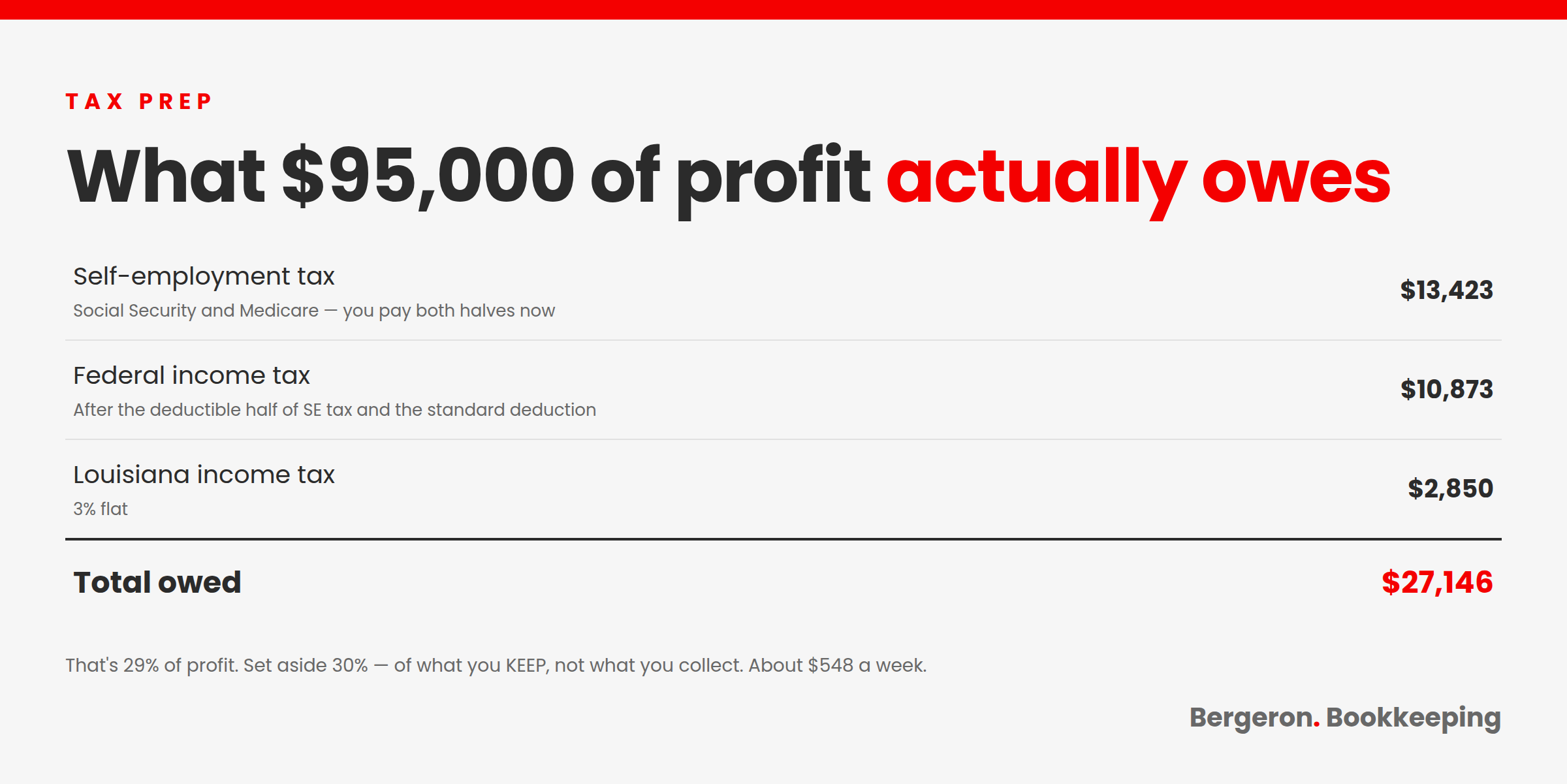
That's $27,146 on $95,000. Twenty-nine percent.
So you set aside 30%. Not of what you collected — of what you kept. Revenue isn't yours. Profit is the number that gets taxed.
Thirty percent is a hair more than you'll owe, which is exactly right. Being a little over in January feels good. Being under feels like April.
The four dates
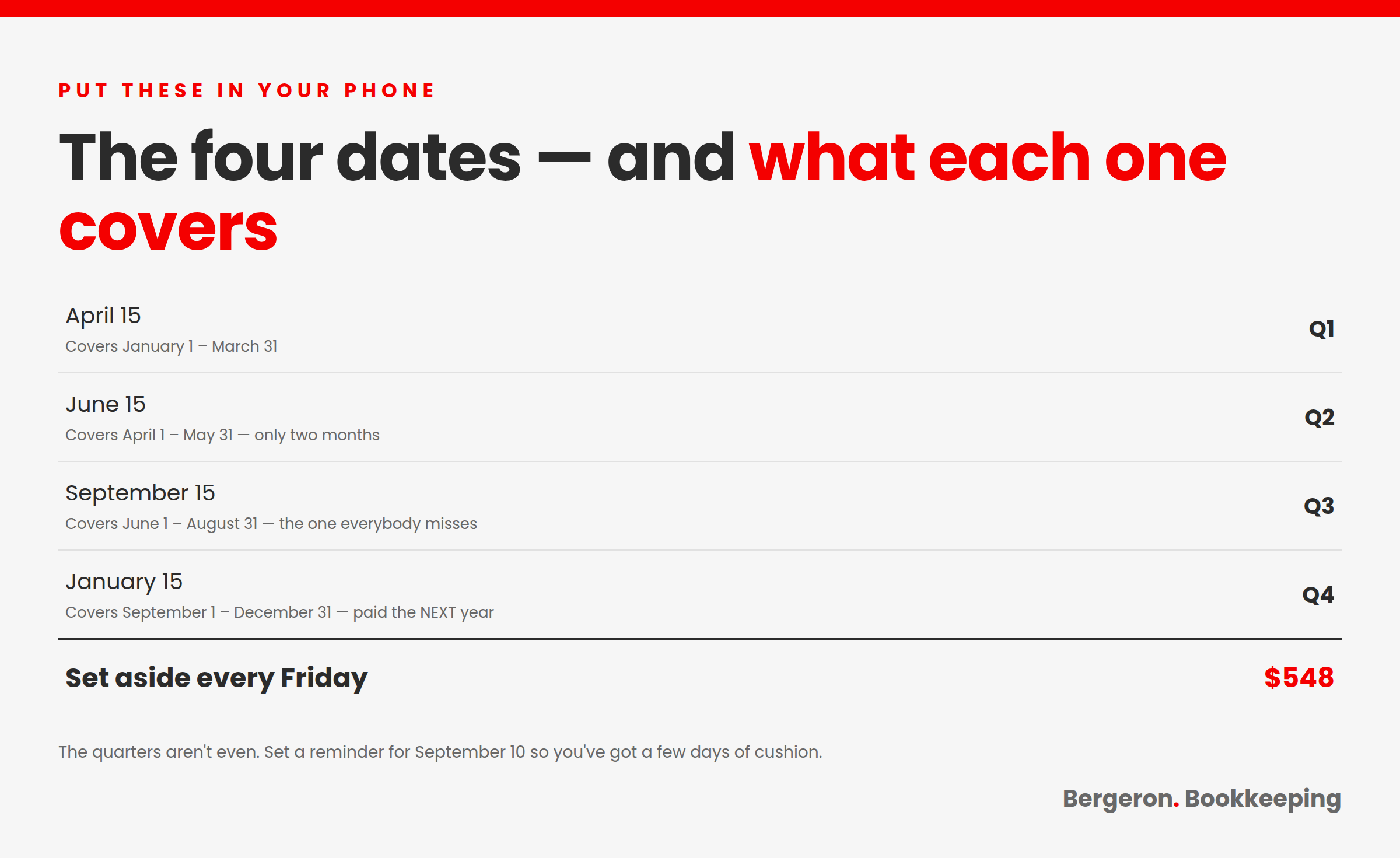
Write these somewhere you'll actually see them.
Two things people get wrong here.
The quarters aren't even. Q2 covers two months, not three. And Q4's payment isn't due in the year you earned it — it lands in January.
And the dates don't move because you were busy. September 15th falls right when fall cleanup season is starting and you're not thinking about the IRS. That's precisely why it's the one people miss.
The trick: a second bank account and a Friday habit
Here's what separates the owners who are calm in April from the ones who aren't. It isn't income. It's one boring habit.
Open a second checking account. Call it TAXES. Never get a debit card for it.
Then every Friday, move 30% of that week's profit into it.
On $95,000 of annual profit, that's about $548 a week.
Five hundred and forty-eight dollars is a number you can actually handle. Twenty-seven thousand in April is not — not because you can't afford it, but because by April that money has already turned into a trailer.
When the quarterly date comes, the money's already sitting there. You make the payment out of an account that was never really yours, and you don't feel a thing.
If you're already behind this year
Most owners reading this haven't paid a dime yet in 2026. That's fine. Do this:
Figure out your profit so far. Not revenue. What's actually left after everything. Your P&L has it.
Multiply by 30%. That's roughly what you should have set aside.
Pay what you can on September 15th. A partial payment beats nothing. The penalty is calculated on what's unpaid and how long — every dollar you send early is a dollar that stops counting against you.
Start the Friday habit now anyway. Even if this year is already messy, next year isn't. The habit is what fixes it permanently.
There's also a safe harbor worth knowing about: if you pay in what you owed last year, spread across the four dates, you generally won't get hit with an underpayment penalty even if you end up owing more. Ask your bookkeeper to run that number for you — it's the cheapest insurance in the tax code.
Why nobody told you this
Your CPA sees you once a year, in the spring, after everything has already happened. By then all he can do is add it up and hand you the total. He isn't being lazy — he just wasn't in the room in July when it mattered.
That's the gap. The tax return is a scoreboard. It tells you what the game cost after it's over.
Bergeron Bookkeeping is in the room during the year. Clean books mean your profit number is right every month, which means your 30% is right every week, which means September 15th is a transfer instead of a panic.
You went into business to build something for your family, not to spend every April sick to your stomach over a number you couldn't have seen coming. You can see it coming. It just takes somebody watching it with you.
Quick recap
30% of profit, not revenue. On $95,000 that's about $27,000.
Four dates: April 15, June 15, September 15, January 15.
The quarters aren't even — Q2 is two months, Q4 is paid in January.
Second bank account, no debit card, 30% moved every Friday.
Behind this year? Pay what you can on September 15 and start the habit now.