The S-Corp Election: Real Numbers on When It Pays Off
The S-Corp Election: Real Numbers on When It Pays Off
Somebody told you to make an S-corp.
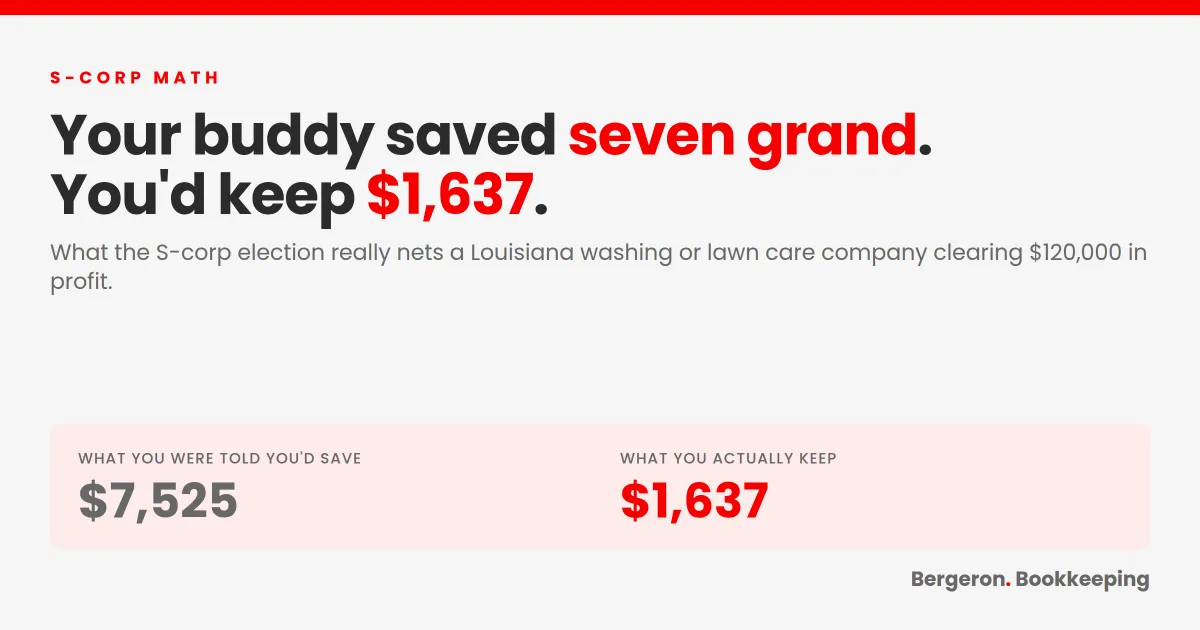
Maybe it was another washer at the supply house. Maybe it was your brother-in-law at a crawfish boil. They all say the same line. "Bro, I saved seven grand."
So you looked it up that night. Twelve tabs open, most of them written by lawyers, and you closed every one of them. You still don't know if you should do it. And the guy who told you to do it can't show you one number.
Lets fix that today. No lawyer words. Just your money.
Start with what you actually made
Say your books say $120,000 last year. That's after the truck note, the fuel, the chems, the insurance, your helper, all of it. $120,000 is what was left for you.
Right now you're an LLC, or you're a sole prop. Same thing to the IRS either way. So you pay self-employment tax on that whole $120,000. It's 15.3%. That's Social Security and Medicare, both halves, because you're the boss and you're the worker.
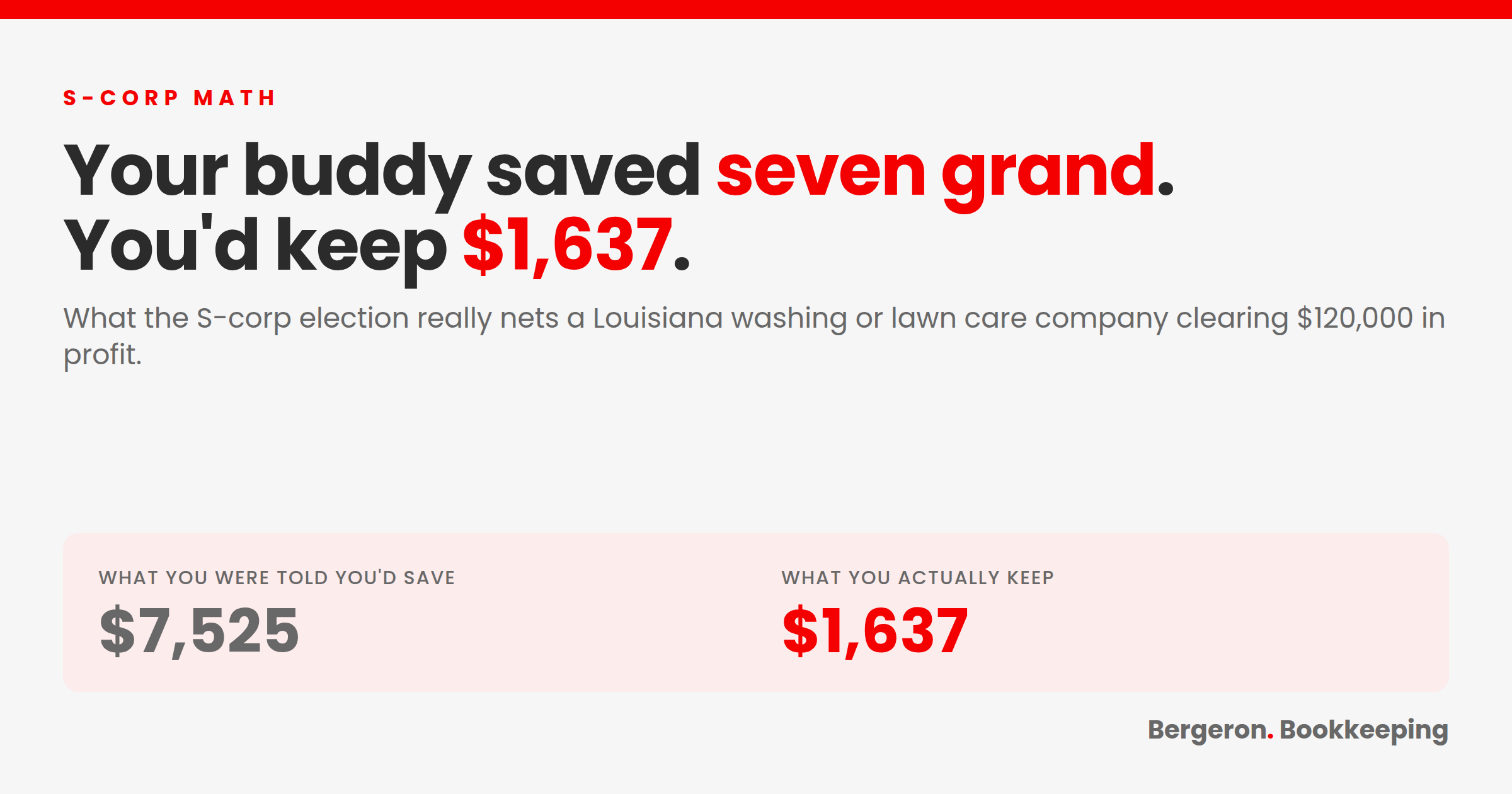
On $120,000, that tax is $16,955.
Read that again. Almost seventeen thousand dollars, before you pay one dime of regular income tax.
That's the number that makes guys want an S-corp. I don't blame them.
Here's what an S-corp actually does
It doesn't lower your income tax. It doesn't hide money. It does one thing.
It splits your $120,000 into two piles.
Pile one is a paycheck. A real one, taxes taken out, just like your guys get. The IRS makes you pay yourself a fair wage first. You can't pay yourself $15,000 and call the other $105,000 a bonus. They will catch that.
For a working owner around here — a man on the wand, driving the truck, running the crew — a fair wage runs about $60,000. That's what you'd have to pay somebody else to do your job.
So pile one is $60,000 in wages. Pile two is the rest, and it comes to you as a distribution.
Here's the whole trick. You pay the 15.3% on pile one. You don't pay it on pile two.
Payroll tax on a $60,000 paycheck is $9,180.
$16,955 minus $9,180 is $7,775. Then Louisiana takes about $250 in unemployment tax on those wages, which you never paid a nickel of before. Call it $7,525 saved.
That's your buddy's number.
He stopped counting there.
The part nobody tells you
There's a 20% write-off on small business profit. You already get it. Every single year. You probably never noticed it, because your preparer just puts it on the return and never says a word.
It works off your profit. Not your wages.
So when you chop $120,000 of profit into $60,000 of wages and $55,000 of profit, that write-off gets cut almost in half. Wages don't count toward it.
Smaller write-off means more money you get taxed on. At 22% federal, plus Louisiana's flat 3%, that costs you $3,728.
Then the bills start. Payroll has to get ran every month. Call it $80 a month, so $960 a year. And an S-corp files its own tax return, on top of yours. Figure $1,200. That's $2,160 gone.
Lets do the math now
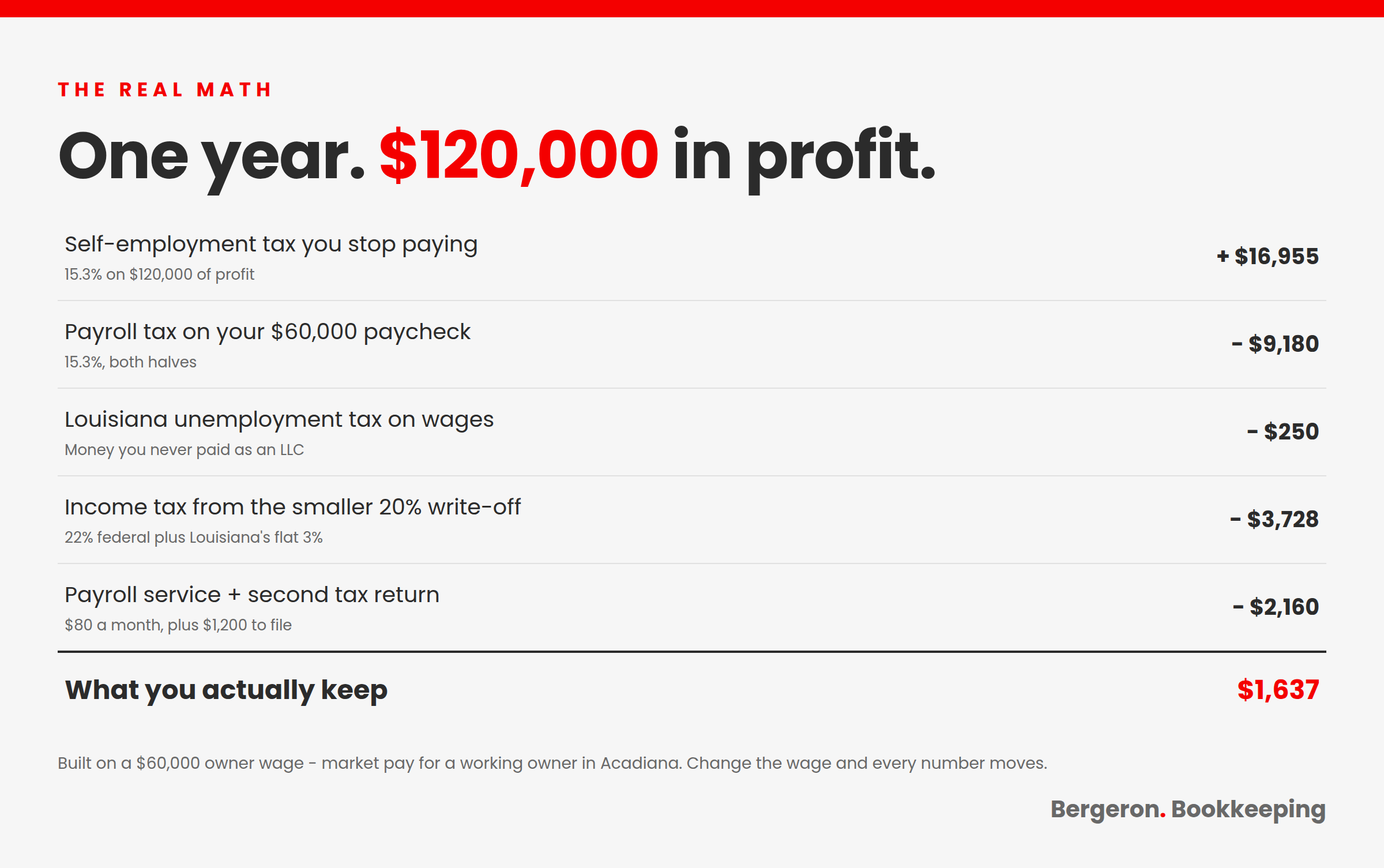
You saved $7,525 on payroll tax. You gave back $3,728 on the write-off. You paid out $2,160 to run the thing.
You kept $1,637.
Not seven grand. Sixteen hundred and change, for a whole year of extra paperwork, a payroll deadline every month, and a second tax return.
Both ways, side by side
Same year. Same $120,000. The only thing that changed is which pile the money went in.
So when does it actually pay?
Here's the good part.
That $60,000 wage barely moves. Your job is your job. But your profit can move a lot. And every dollar of profit above that wage is a dollar that skips the 15.3%.
Watch what happens as you grow:
At $80,000 in profit, the S-corp costs you $3,448. At $100,000, it costs you $905. At $120,000, you keep $1,637. At $140,000, you keep $4,181. At $160,000, you keep $6,724.
The line crosses right around $110,000 in profit. Under that, an S-corp is a bill you pay for nothing. Over it, it starts paying, and it pays you more every year you grow.
And I know what your thinking now. "Alright, so I just wait till I hit $110,000." Careful. That's $110,000 in profit, not $110,000 in sales. A washer doing $260,000 in sales with two trucks and three guys might only clear $85,000. A solo guy doing $150,000 out of one truck and a trailer might clear $115,000. Sales won't tell you. Only clean books will.
One more Louisiana thing, and it's the one that bites. Once you're on payroll you're an employee of your own company. Here, an owner-officer can file to be left off the workers' comp policy. If you don't file it, your own $60,000 paycheck lands on the comp audit and you pay premium on it. On a washing or landscaping class code, that premium can eat the whole $1,637 and then some.
Why nobody showed you this
Because the math I just did takes ten minutes, and nobody bills for ten minutes.
Most accounting firms are not in your corner, they are in your wallet. An S-corp means a monthly payroll fee, a second return, and a bigger bill every April. They have every reason to tell everybody yes. They have zero reason to tell you that at $95,000 in profit, it's a losing trade.
That's the false profit narrative again. It looks like a win because nobody made you count the other side of it.
We do it different. Everything above, you can run on a napkin at the kitchen table tonight. That's on purpose — the method is free and I'm not holding a piece of it back. What we sell is doing it for you every month, and a phone call the month you cross that line instead of two years after.
What this is really about
That $1,637, or that $6,724 when you grow into it, isn't a scoreboard. It's a set of tires. It's the deductible when the trailer gets rear-ended on the Evangeline Thruway. It's Christmas that doesn't go on a credit card.
You started this alone, back when every dollar that came in felt like profit. Now there's a crew. Instead of one mouth to feed, you're feeding yours, your family's, your workers', and theirs. That weight don't lift because you filed a form with the state.
It lifts when you know your numbers.
The short version
Self-employment tax is 15.3%, and right now you pay it on every dollar of profit.
An S-corp only saves that tax on the profit above your paycheck.
You give part of it back in a smaller 20% write-off, plus about $2,160 a year in payroll and filing costs.
Under about $110,000 in profit, an S-corp costs you money.
Over it, it pays — and it pays more every year you grow.
Sales don't decide this. Profit does. So know your profit.